
One Book Earns Me $1,500 a Month on $150 in Amazon Ads. Here's the Honest Math.
By Tony · Last updated
On this page
Summarize with AI
I've been publishing on KDP for over three years under pen names: 10 books, more than 25,000 copies sold. KDP isn't my main income, and I'm not actively publishing new books right now.
So this isn't a "quit your job" post. It's what one book that found its readers looks like, with real numbers, because when I was starting out I would have paid for a post like this.
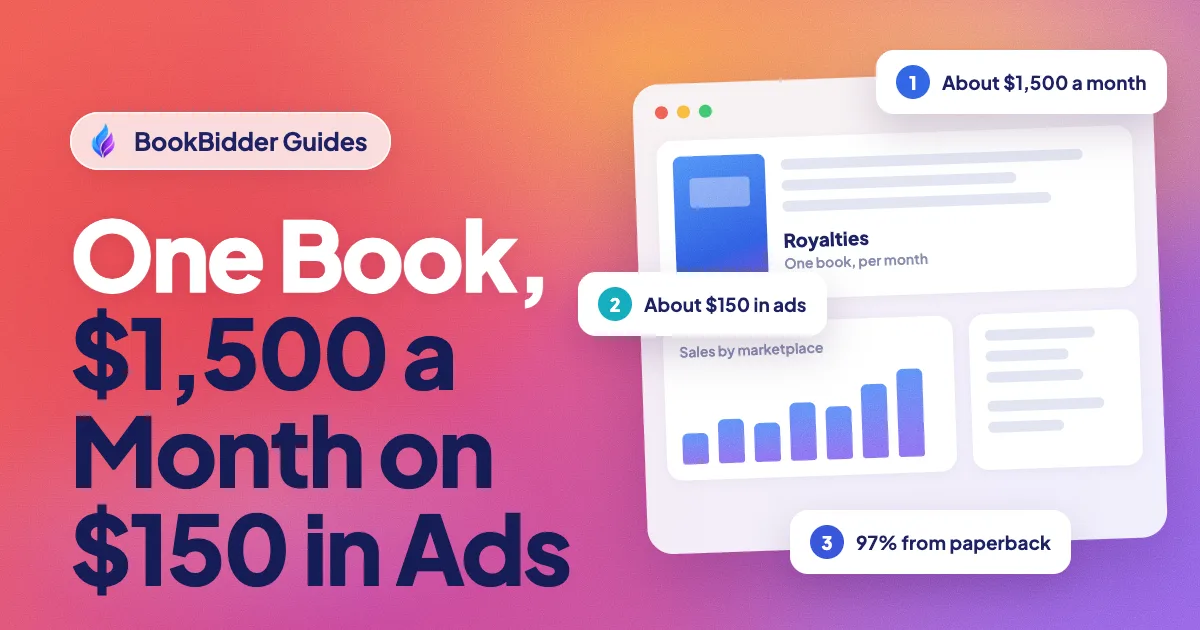
The numbers, rounded: one non-fiction book brings in around $1,500 a month in royalties. I spend about $150 a month on ads for it. That's roughly 10% of royalties going back into ads. The other 90% of what drives it is organic.
The honest context: this book used to earn quite a bit more than $1,500 a month. A shift in focus, since I spend most of my time on software now, falling search demand for my main keywords, and plain neglect brought it down. These days, ads across all my books run automated through BookBidder, the tool I built, which keeps them selling without me touching the campaigns; the catalog is in maintenance mode, not growth mode. I'm confident more time and energy on the books would bring the numbers back up. That cuts both ways: $1,500 isn't the ceiling, and it isn't passive magic either.
One more number that surprises people: about 97% of this book's royalties come from paperback. For non-fiction I focus on paperback because the profit margins are higher, and it's worth ranking the paperback above the Kindle edition for that reason.
What surprised me most
It didn't break out in the US first. It started ranking in the UK, and later became a bestseller in Canada. It still hasn't gained much traction in the US, partly high competition, partly my own negligence.
Key insight: If you're only watching your .com rank, you might be missing where your book is actually working.
What actually made the difference
- The book converts. Cover, reviews, listing. When readers find it, enough of them buy it. Everything else is downstream of that, and it cannot be overstated. If you don't have this down, everything else falls apart.
- Organic rank compounds. Sales lift rank, rank brings readers who never saw an ad, and those sales hold the rank. The ads console won't show you any of this.
- Ads are the amplifier, not the engine. $150 a month keeps the book visible on searches where it already sells. For a non-converting book, ads just amplify the drain on your budget.
Key insight: Ads are the amplifier, not the engine. $150 a month keeps a book visible where it already sells; for a non-converting book, ads just amplify the drain.
Step-by-Step Playbook
This is the structure I'd give any non-fiction author starting without an audience:
- Niche first, before writing a word. For non-fiction this is 80% of it: find a topic people already search on Amazon, with real buying demand and covers and listings I could beat. I use BookBeam to evaluate whether there's significant search volume that signals demand. Look at who's ranking on the first page, particularly the top two rows. Bad reviews and bad covers mean you can rank better than them.
- Make the book convert before spending on it. Don't get fancy with the title: make it clear so readers know what they're getting. Use a cover that holds up as a thumbnail next to the niche's best sellers, with a title that says what problem it solves. Treat the cover like a marketing A/B test: create multiple covers before publishing so you have them ready. And expect 20 to 30 reviews before ads get real money.
- Discovery ads with conservative bids. Auto and broad match cast an infinite net of search terms. Then a weekly search terms report: negate the junk, promote what sells to exact match. If you're doing a launch, the focus is getting data, not ACOS. Once you understand how the book performs based on data, adjust. Low CTR? Change the cover. Poor CVR? Improve reviews and the listing. In a competitive niche, expect to pay to play at first: spending past break-even for a while is sometimes the cost of proving the book deserves its rank.
- Judge against total royalties. One campaign's ACOS doesn't tell the full story. I judge ads against what the whole book earns.
- Follow the sales, not the map. The US is the biggest market, but my book took off in the UK organically, so I put the ads there and scaled. I look at which countries show organic sales, then test the water with ads to increase visibility and capture the demand that's already there.
On the international angle specifically: I first ran ads for the US, then noticed I was getting sales in the UK. So I ran ads for keyword-adjacent terms specifically for the UK, because I was already ranked #1 for my main keyword there. As an illustration: if your main keyword is "sourdough bread for beginners," adjacent terms are "easy bread baking" or "sourdough starter guide." After a year, it became a bestseller in Canada, and I started running ads there too.
A note on genre
Mine is non-fiction, which lives on evergreen search: people type a problem into Amazon, the book answers it, so the engine is ranking for those searches and converting.
Fiction tends to work differently. From authors I've talked to, the winners often don't have large audiences either, but they lean on read-through across a series, Kindle+ page reads, and promo platforms that already have big reader audiences. Different engine, same principle: the book has to convert once readers see it.
If you don't have an audience
You can do one of two things: commit 1 to 2 years to building an audience so you can sell your book, or spend hours finding the right niche with high demand that will propel you to profit without an audience, because the audience is already searching for those specific keywords. Years versus hours; I chose the latter.
Key insight: Years versus hours. You can build an audience for years, or spend hours finding a niche where the audience is already searching.
The honest caveats
I'm not claiming this is repeatable on demand. I have other books that never did this, with ads behind them, and the honest lesson there was that the market had given me its answer. Getting to #1 improves your chances tremendously; it guarantees nothing. There was an element of luck involved, and I'd be lying if I said otherwise.
Related
Frequently asked questions
Are Amazon ads worth it for authors?
They can be, as an amplifier. On this book, $150 a month keeps it visible on searches where it already sells, and the other 90% of royalties is organic. For a book that doesn't convert, ads just amplify the drain on your budget, so fix the cover, reviews, and listing first.
How much should an author spend on Amazon ads?
There's no universal number, and anyone who gives you one is guessing. The 10% of royalties in this post is where one established book settled, not a rule. Early on, the ratio is usually worse: even with a book that converts, a highly competitive niche can mean paying to play for a while, spending at a loss to prove to Amazon that your book is worth ranking higher in the search results. The spend that matters is the one you judge against your break-even ACOS and the book's total royalties, not a fixed budget.
Do you need an audience to sell books on Amazon?
No. You can spend 1 to 2 years building an audience, or spend hours finding a niche where the audience is already searching Amazon for those specific keywords. This book had zero audience behind it; the niche carried it.
Why did the book rank in the UK before the US?
The US is the biggest and most competitive market. The book found organic traction in the UK first, so the ads followed the sales: keyword-adjacent UK campaigns while it was ranked #1 there, then Canada after it became a bestseller there. Watch every marketplace, not just .com.
Should non-fiction authors focus on paperback or Kindle?
For this book, about 97% of royalties come from paperback, and margins are higher there, so the paperback outranking the Kindle edition is worth pursuing. Kindle can still be lucrative; this book just earned its living in print.